Art by Jen Watt
Exposure
by Theresa Ryder
They knocked the club down. The long wooden sign fell with the first blows. It was left where it landed, face up in the mud making its final declaration.
NW LONDON WORKING MEN’S CLUB
MEMBERS ONLY
I kept a daily vigil from the bridge to watch the progress. Sent videos to Trish. We’d found each other on Facebook recently but the wedge of years stifled our communication. She’d aged into a mumsy type with a grey bob, her home page loaded with photos of romping dogs. I hadn’t changed so much, still in jeans, an occasional denim and lace combo for a special occasion. Except my hair which Trish had known as short, spiky and vividly streaked. It now took as much effort to keep it long, straight and black. But I put our differences aside. This was news of a magnitude that I knew Trish would understand.
On day five the weathered façade collapsed exposing a maze of empty rooms like the open front of a doll house, but one of rotting beams, bent pipe and shattered brick. Then for a while it was hidden by canvas sheeting. I moved to ground level, snared one of the builders to ask why.
‘Asbestos. These old buildings are thick with it.’ He picked flecks of white from his Super Mario moustache.
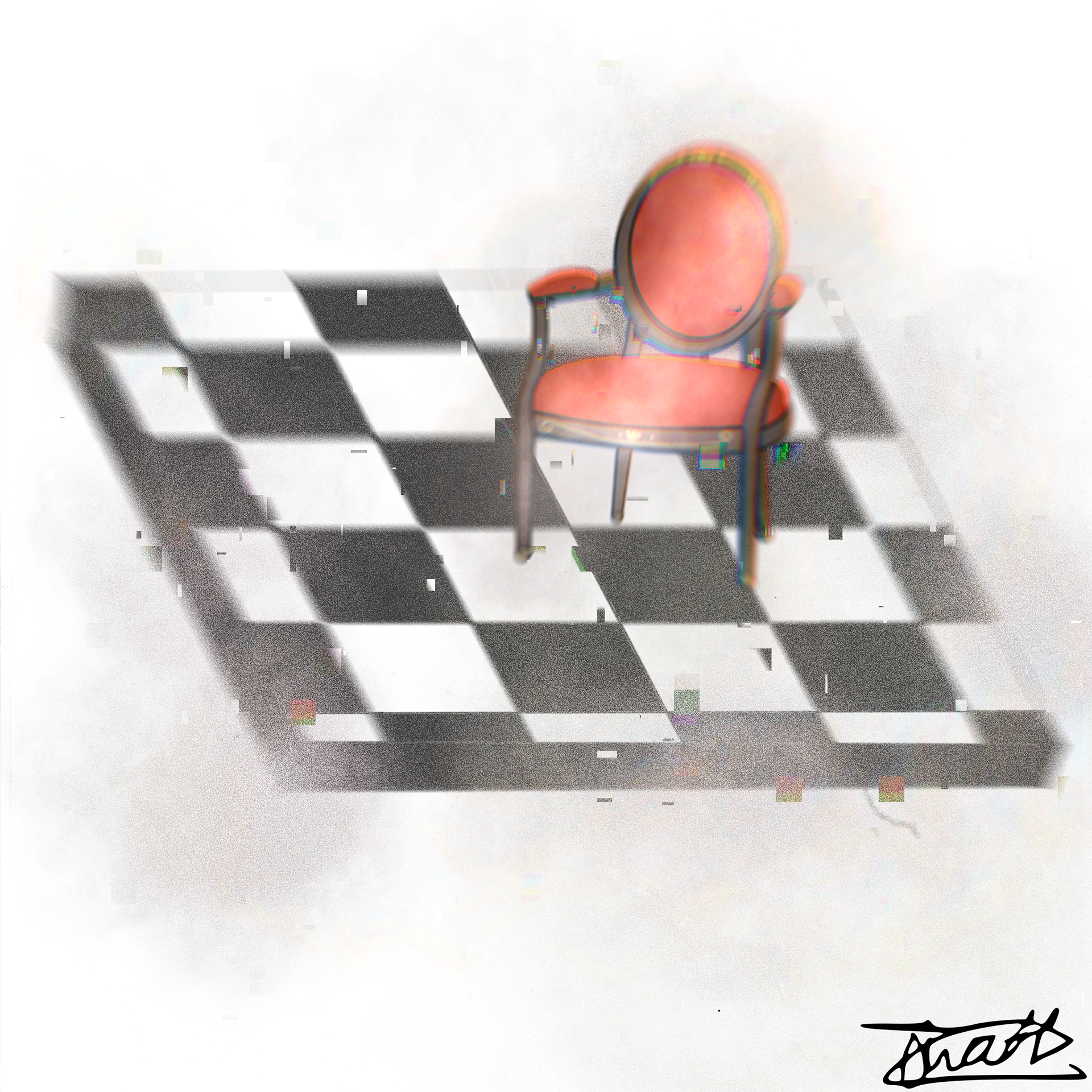
When the poisoned dust settled they removed the covering and exposed the chair. Like a magician’s trick. It hadn’t been there before. It sat regal amongst the dust and rubble, four legs stable on a base of black and white tiles. I was familiar with the red velvet seat and gold-tinted frame, just like all the others we had stacked around the dancefloor. But this one had never been piled with the others. I leaned in for a close-up, thumbed a message to Trish.
The tiles are black and white!!
I held back on a smiley emoticon. It didn’t seem appropriate. Before I could hit send I dropped the phone inside the railing. I reached over, eyes on the chair, and snatched it back as if a rabid dog waited on the other side. The cracked screen rattled.
‘Alright there?’ said Mario.
‘Wanted a photo. I worked here years ago.’
‘Right. Big place. Two floors above the bridge. Two below the railway line.
‘I remember. Lots of rooms.’
‘You worked the bar?’
I nodded. The club had been a training ground for bar workers. Shit pay but great experience. My turn was in 1979. My first paycheque bought Pink Floyd’s The Wall. It was all I could talk about. I still play it on that original vinyl. It’s still worth talking about.
Trish, Alan and I began our first shift on a Wednesday night. The day before payday and dole was quiet, the best night for novices. I had never pulled a pint. It took me a while to learn the dance that goes on when three people are serving in a small space. You have to know the orders of all the customers, not just your own. Get to know who will be doing a deep pour or a high reach. It was a popular spot for stout. An Irish crowd. Mainly old men who had long left the homeland to stack bricks, lay motorways and live a life of yearning for field and bog. We three were London natives born to Irish parents so we understood them and their maudlin songs, curses, and drinking habits. A different type of drunk to the younger crowd, they were long-term abusers with digestive systems accustomed to volume. They didn’t vomit but their brains were fried. My preferred type of drunk.
We were the “plastic paddies,” Irish when it suited us, rejecting it easily. Happy to load up on cheap drink in the club hall, falling around trying to jive like the old ones to some shite country band. Then we’d leave for the pub gigs, pouring scorn on the old boys weeping into their pints about some grey Irish town they had left behind. The sort of place I’d been dragged to as a kid every summer holiday where flowerless streets were shadowed by old town barricade walls. There was a uniform dullness to the shops. I suspect the newsagent is still there, selling bags of penny sweets, donkey-carrying-turf postcards, and unwrapped blocks of black-crusted bread that sat on the worn plywood counter.
The three of us always worked the same shift. Being eighteen and bored, Trish and I both made a play for Alan. It caused a bit of tension but otherwise we got along ok. Neither of us actually wanted Alan. He wasn’t anyone’s type with his medallion brushing against his low-buttoned chest. I touched the big silver slab once and he flinched as if burned.
‘What is it?’
‘Saint Christopher. Patron saint of travellers.’
‘You going somewhere?’
‘I’ve got plans. Save my wages.’
Trish was messy. She drank on the job and screwed up the till, which got us all into trouble. Management, a committee of old timers, would fall for her coy smile and flick of blonde hair and let it go. I didn’t work that way, I wore jeans and punk hair. But I wasn’t daft, I knew that a low-cut top got you tips. I don’t know how Alan fared but most of the old dolls would fawn over him when they were tipsy. Finger-beckoning him over to clutch his medallion in varnished talons, salacious smiles creasing their powder-layered faces. He’d throw us a wink and go willingly. I guess he did alright.
Alan did the keg lifting, leaving us girls to wipe sticky counters and mop floors. Management approved of this gender delegation, sitting behind their pints watching Trish leaning over tables. I know she wiggled on purpose.
It was safer behind the bar. The drunks couldn’t paw at you and we could pull back from halitosis and spittle. At one end of the counter was a cubby hole containing a bench, a stool and a kettle. On the wall was a screen with various CCTV camera angles. This was the entertainment on our breaks.
There were twelve monochrome images. They showed the entrance, front bar, snooker room, various views of the dance hall and stage, keg room, basement, and multiple external doors. But one camera was in a room that housed just a chair on a square tiled floor. We couldn’t tell what colour the tiles were, we guessed just black and white. But the chair was the same as the ones from the dance hall so we knew the colour of the scuffed frame and seat, the velvet likely pocked with cigarette burns.
What bothered us was that we couldn’t locate the square tiled room. All the rooms we knew had wood-patterned lino or concrete. Nothing ever changed in the tiled room but we watched it with a growing interest during our breaks. Our obsession peaked the night Alan got hold of the skeleton keys.
‘Game on, girls. We can open all the doors from basement to roof. You up for it?’
‘Only if we go clubbing after,’ I said. It had been a tough shift with a funeral crowd. Once the sandwiches were eaten and the children taken home, the hard-core drinkers had settled in for a raucous celebration of an old man’s passing.
‘I’ll go if I don’t get covered in cobwebs,’ Trish said, shaking her hair over her face as if already contaminated.
An hour after closing time once we’d released the last punters onto the streets to sing their sad songs as they wove home, we poured ourselves pints and sat to plan. Alan was armed with a big battery torch and we giggled over the tension that bounced between us at the task ahead. Trish sank three shots of vodka.
‘For the nerves.’
We began the search in the basement. Alan led with the torch, Trish and I shuffling close to his shoulder keeping within the limits of the beam. Most of the internal doors opened without the need for a key.
‘Shine the light on the floor and we’ll know if it’s our room,’ I said, reluctant to go further into the stale spaces.
There were six doors on that lower level and none had square tiles. We climbed a stair. Alan moved some kegs blocking a fire door but that just led to an alley with metal stairs up to the back of the stage.
‘Close it, I’m freezing,’ said Trish.
By the time we got to search the upper floors we had warmed up with the aid of my hip flask. But we didn’t find our mystery room. Alan set the alarms and we headed off to catch up on our drinking. We sat in a morose huddle at a disco bar. Not speaking much, we swayed to pulsing pop beats that would normally have us leaping around the dancefloor in after work relief.
The next night brought the rat. Trish was on her break. She screamed and knocked over the stool as she fled the cubby hole.
‘It ran across the floor,’ Trish said, fear-laughing with one hand to her throat. ‘It was huge.’
‘Ugh, where?’ I stepped back, searching.
‘Not here. In the tiled room.’ She pointed back at the screens.
I went to look. Alan, confined by a Guinness pour, leaned backwards to try and see the screen, froth seeping down the pint glass.
‘Nothing there now,’ I reported back.
After closing we replayed it. Trish screeched again when the rat ran across the tiles. It stopped under the chair, turned its snout to the camera.
‘That’s freaky. I’m not going looking again,’ Trish said, rapidly rubbing her arms.
‘We probably disturbed it, poking around last night.’ St. Christopher jiggled as Alan ran nervous fingers through the chain.
I wasn’t in for a few nights after the rat. Trish worked the shifts with Alan. When I turned up for work she beckoned me to hurry behind the bar.
‘What’s up with you? It’s not busy.’
‘It’s Alan. It all kicked off here last night.’
I pulled up a high stool. ‘Go on.’
‘It was bingo night so Doreen was in.’
‘Never misses the bingo. She was the usual pain in the arse?’
‘Worse. She was annoying Alan all night. When he was clearing tables she stood in front of him and put her hands in his back pockets. She was trying to dance but could hardly stand.’
‘Ugg. She’s so fake. Tan, fur, and flashy jewellery. Cruella Deville without the dogs.’
‘Yea well, she had a rottweiler. Frank came in.’
‘He’s never in for bingo.’
‘This time hubby turned up. And Doreen was well on. Alan pushed her away and Frank landed him one. Then Frank turned to punch her but Alan pulled him back.’
‘God, I miss everything.’
‘Full on fight. Frank pounded Alan of course.’
‘Naturally.’ I imagined the scene. Poor skinny Alan at the hands of big Frank. ‘Is Alan ok?’
‘No idea. He’s gone. Sacked I reckon.’
‘How’d he get home?’
‘Dunno. I got busy here. I guess they got him a taxi.’
‘Probably licking his wounds. Give him a day or two.’
‘There’s more.’ Trish pointed into the cubby hole. ‘I can’t look again.’
I knew which camera she meant. On the chair lay the mangled remains of the rat, but only the dangling string of tail indicated its former state. I peered in, the picture fuzzy as I got close to whisper.
‘Where the fuck are you?’
Rumbling diggers tore me from my thoughts.
‘Stand back now,’ yelled Mario.
Shouts drew Mario away to a gathering of men looking into a gap to a lower floor. A siren drifted. The men were distracted, the diggers idling and I had been curious for too long. I slipped over the railing and took off in a crouched run. I almost made it to the chair when I tripped on rubble and stumbled forward. Arms out to stop my fall, my hands were heading straight for the red velvet. My mind flashed an image of the rat. I recoiled and fell hard to the ground beside a gold-painted leg.
‘Shit.’ I blew on my grazed palms and rubbed dust from my eyes. The movement caused a sharp pain in my shoulder. I flinched and rocked the chair. Something shifted on the seat. The medallion dropped, the chain caught around the frame. It swung lightly from the weight of its own release. I was eye level with St. Christopher.
A hand on my elbow steered me back behind the rails where I hunkered down to watch the chair. Vaguely aware of pulsing blue. Police moving among the builders, waving them away. Then a shout. Crash. A high rise of dust. One scream. More sirens. Mario lifted onto a body board. His hardhat remained where he had placed it on the chair when he led me away. I followed St. Christopher’s rhythmic hypnotist’s sway, the sun glinting off the aged silver like a winking eye.
About the author:
Theresa is a writer and teacher. She holds an M.A. (Classics) from Maynooth University. She was awarded the Molly Keane Creative Writing prize 2015, Northern Soul Roadshow 2024 and Bealtaine Emerging Artist 2024. Publications include: The 32: Anthology of Irish Working Class Voices, Same Page Anthology, From the Well competition Jellied Minds Anthology, The Honest Ulsterman, The Waxed Lemon, The Irish Times, and Eat the Storms podcast. She is currently writing a memoir developed under the National Mentoring Programme and aided by an English literature bursary from the Arts Council of Ireland.