Art by Nadia Uddin
The View
by Pete Armstrong
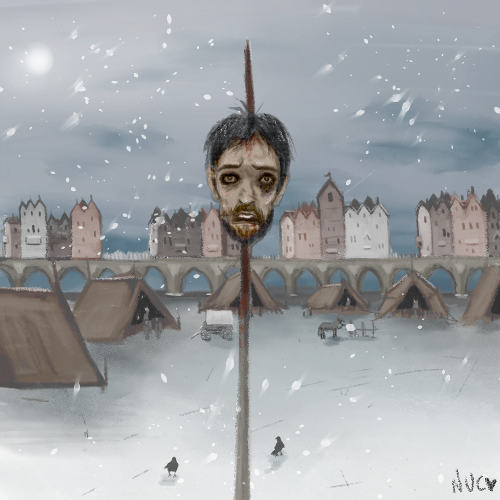
From my vantage point I have a good view of London Bridge and the Thames. It is a cold evening, the feeble warmth of a winter sun is sinking into dusky shadows. The river is frozen, thick enough to support the frost fair. Wooden stalls are laid out upon the ice, heaped high with vittles, metal plates and furs. Old memories are kindled by the reeking brew which reaches up even here. There are spices to make my mouth water, garden produce, hung meat. Animals are everywhere, not just horses but a multitude of beasts are tethered to wagons, even to iron rings driven directly into the ice. An easterly wind sweeps up the acrid stink of these creatures and mixes it with the sweet fragrance of meat and fruit. It is a rich blend of aromas, and I suck in the most overwhelming of them, seeking to drive from my senses the stench of frost fairs in the past; of rotten flesh, betrayal and bloody gore that has lately filled my nostrils.
My troubles began when I first mumbled careless treachery in a drunken session with Gatland. This was in Suffolk, far from the Queen's eyes and ears at Court. I had no political aspirations, some wine-soaked rabble-rousing in a country dining room, when sensible men were a- bed, was the extent of my rebellion. Such heresies were not to be repeated in town, not if you cared to keep your head.
So I was surprised and not a little horrified when Gatland later appeared at my townhouse and spoke in hushed tones of an uprising, causing thrills of terror to run up my spine to even hear such words. I had the most fleeting of opportunities to refuse him and save my soul, but against my better nature I submitted to his flattery and hence bound my fate to his. I must have been mad.
We would meet at the fair, wander around the tattered tables and whisper conspiracies. Where better to speak unheard than amidst a babbling hubbub of other voices? We equipped an army, murdered the Queen and placed one of our own upon the throne all within twenty stolen minutes. Then we returned our attention to the vittles and trinkets as if that was all we desired of the day.
During those weeks, doubts and fears tormented me. My wife received only angry recriminations; each night I gorged myself into a drunken stupor only to wake in the devil's hours and drink more.
The end arrived unannounced. I remember still the crash in the midst of night, as the front door splintered against the jamb. Footsteps of intruders ran hither and thither across the downstairs rooms. My wife's hands clutched my bedrobes as she sought reassurance in her panic, but there was none to give. The mob mounted the stairs, fury bubbling before them, and violently cast aside the curtains around our bed. The die was cast and I was going to hell.
I endured three days in the Tower. It is a filthy, putrid place, even the rats avoid it. Already, memories of that time regress into patches of grey amidst the black. The very stones bit with frost, there being no bedding or even straw to protect me from their hard embrace. The Queen's men burnt my defenceless flesh, demanding information I knew not. I wept piteously, yielding to their cruel eyes a betrayal of anyone I knew, living or dead. They cast aside my savaged body only after my screams had simmered into mad ravings.
The terrible hours of darkness anticipating my final journey were worse than the day itself. I prayed for night's endless protection, but the sun rose regardless and when the first part of my ordeal ended it meant only that the second was to begin.
They cast me into a wooden cage and dragged it from the prison to Tyburn, the people jeering and hurling stones at me. At first I felt each blow keenly, but soon my senses arose up from the grisly carnage below. As if from above I merely observed each new gash and bruise bursting out across my ragged skin.
When we reached the place of execution the crowds were parted to release my pathetic bag of bones for its next bloody trial. Limbs were ripped and torn; rude tubes from within exposed and ruptured; component parts dragged through the mire. I witnessed this as one of the mob, beyond any intimate connection to the biological debris I had become.
Finally, what remained was held up on the platform and my own shocking, final moment, such as I had witnessed for other men with a blend of interest and horror, lasted but a heartbeat. They cast me down and the blade struck. I was separated from my body and felt only relief. It had become such a shredded mess of pain and indignity that I was glad to see the end of it.
And yet no heavenly journey enabled an escape. I remained upon the platform. My ears rang with the roar of many voices singing in jubilation, then I was flung into some rough sack and blackness closed upon me.
The next journey was jarring again—will no one design a wagon that can ride smoothly through the streets?—and so we arrived here.
I thought my sufferings had ended, but this spike driven through me caused the most tortuous pain of the whole day. I was beyond crying out, but was aghast and insensible of my surroundings, such was the agony.
As the sun completes its descent I can focus once more on the view beyond. Gatland is, I know not where, no doubt undergoing a similar journey. The pain from the spike has eased to a dull ache; the frost fair draws to a close; final bargains are being struck with the desperate before the food spoils. Shadows grow longer and I find myself welcoming the dying of the light.
About the author:
Pete lives in a leafy suburb in Central Sweden. He spends his days in blue jeans, looking after children, and writing stories.
His stories have appeared in numerous journals, including Wells Street, Art Ascent and Strukturriss. He has been a finalist for LISP, New Millenium and Hawkeye, and won a micro competition for Globe Soup.
In his spare time, Pete is a volunteer storyteller for the very young and he plays a little Bach on the guitar. He loves hiking in Swedish skog, trying not to bump into moose. Again.
His stories have appeared in numerous journals, including Wells Street, Art Ascent and Strukturriss. He has been a finalist for LISP, New Millenium and Hawkeye, and won a micro competition for Globe Soup.
In his spare time, Pete is a volunteer storyteller for the very young and he plays a little Bach on the guitar. He loves hiking in Swedish skog, trying not to bump into moose. Again.
Find more on: armstrong99.com/Writing