Art by Jen Watt
Irish Dancer
by Will Gordon
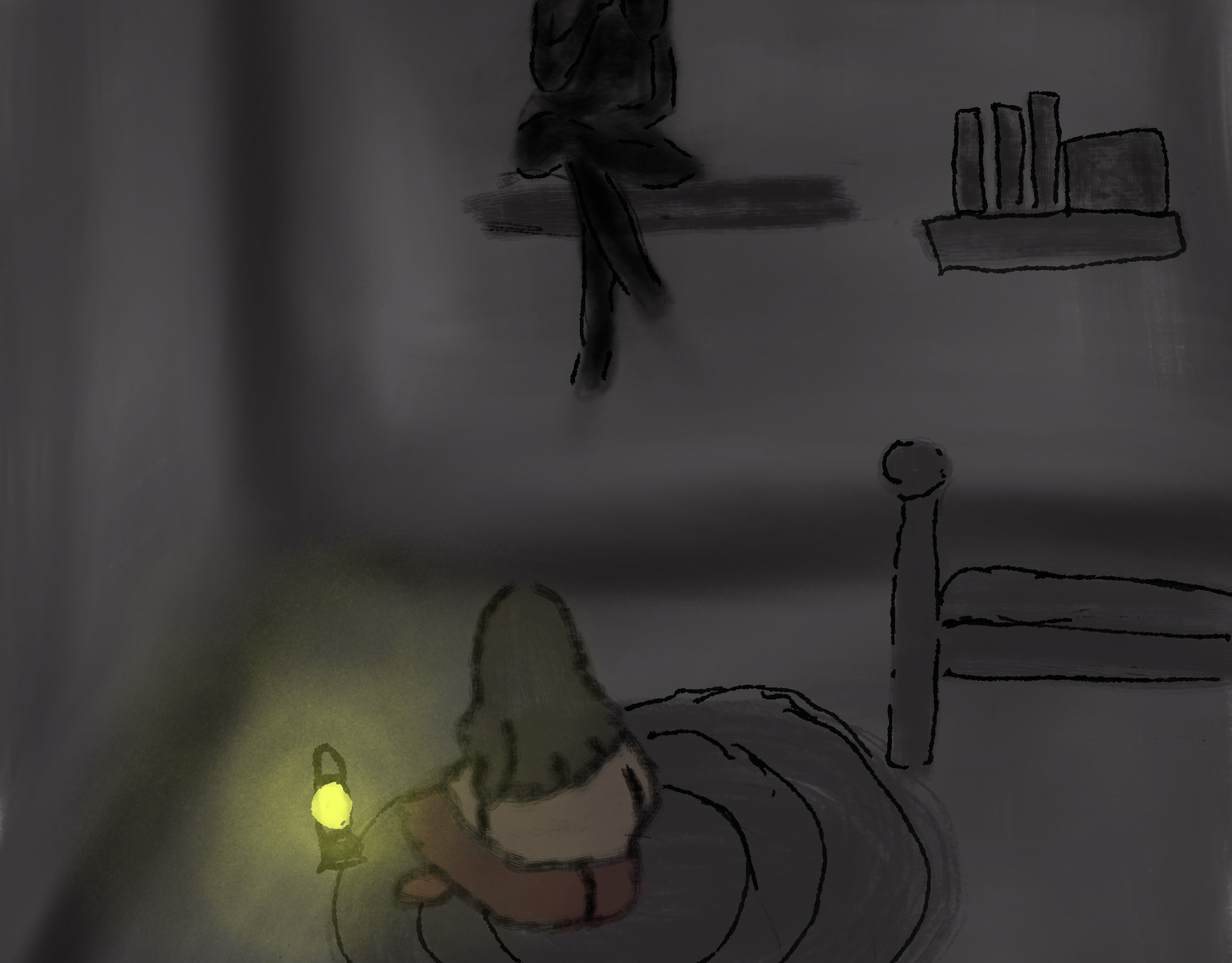
It was no matter. Even with someone different than Father Jennings on stage. Built into the stained-glass window behind the pulpit, Saint Francis of Assisi still stared blankly. Body and eyes looking left, over the south transept, away and indirect. His words long forgotten to a different time. Different people. The new didn’t change the old. All of it was no matter. A year since his wife passed. He, Wendell, the teacher. Used to be beloved. Now pitied, or past pity, whatever lives there. He hadn’t felt much in those long, repeated days. This particular Thursday wouldn’t be any different. He’d even gotten good at telling himself so.
But the stranger stood tall on stage, a younger man. Black dress shirt. Worn jeans. Long, heavy boots. Violin in one hand, bow in the other. He took a deep breath against the mic.
“We must hold it just right. Like Goldilocks. I call this Irish Dancer.” The noise that emerged. A steady sound from the stranger’s violin, pure in note, enough to stir Wendell immediately. A shuffling to bottle it up.
Sweet swooning rushed through the chapel. With the angled ceilings, the sound bellowed and bounced through the entire space. This note lingered for two, maybe three full moments. The stranger tapped his foot once, then twice, the space between the size of the word “caterpillar.” Then a full-on entry to his Irish song.
Lightning fingers, a shock of auditory rising and falling, pressing the strings into the fingerboard like they were climbing little staircases. The stranger rocked his body back and forth, and instinctively, Wendell mimicked him. What was happening? More shuffling, resting hands on thighs, calm the self down. Students noticing. More rising and falling, though, musical medicine, and the mimicking returned. Somewhere between smile and shock, a soft, curved opening of the mouth, rested on his face. Even when Wendell himself locked eyes with a nearby student who looked less than impressed, his smile didn’t leave. That can’t be right. One more attempt at restraint, let the steady numbing return.
Or, try to force the numbing, feeling too much, even, what is the line between joy and overwhelm. So, look at the mural of Saint Francis again, collect himself. Wait. That can’t be. Was Saint Francis now looking his direction? His eyes heavy, peering, being seen again, this can’t be real, none of this can be real. The music churning, slipping into cracks like grout, how could he not react and respond and fall back into something. Yes, in Wendell’s mind, whether he liked it or not, that beautiful chapel had shifted, transformed. Instead of the pulpit and surrounding stage, the floor was opened, empty and awaiting invitation. Not only that. Old, dark, creaky oak boards now a brighter, shinier yellow birch. The light from the window, that heavenly sent array of homebound beams Saint Francis casted down through his window brightened up the room even more, music still talking, Wendell fully taken.
Where the stage had been, a small crowd had gathered. Ghastly figures, with stretched limbs that branched out like a searching phantom in the dark, formed a circle. Human enough, their suits and dresses, which came in many colors – a daunting red, a 19th century blue, a Gatsby green, and a sunrise yellow – rotated with their bodies. They were in arm-lock, spinning as one big group, circus love. Wendell watched this kaleidoscope.
The stranger’s song slowed in tempo, and in response, the spinning slowed, too. It was then, through whatever veil they’d created before, that Wendell noticed a figure in the middle. Something deeper jumped inside of him, but before he could see more, the group suddenly shuffled into a horseshoe, with the two bodies on the bottom curve, both wearing a shiny, velvet black, holding hands, while the rest of the dancers filled out the longer, side curves. Their dancing feet, hopping in a two-step rhythm with the slowing sound, shimmied until one member from each side came together and danced away as a pair wearing the same color. This process repeated itself until just the two at the bottom of the curve remained, a tiny wall, the other pairs spinning and dancing all around them.
The tug inside Wendell’s soul was incalculable, how they try to describe rip currents on long, stormy voyages, a yearning like the long-sitting dust on the windowsill next to her hospital bed that felt wrong to clean away. He felt compelled to stand, to see through the wall, break it down with his own fingers. Then, as the stranger let a moment of silence pass, the two figures creating the wall, with their backs turned, let go of their hands and split apart from one another, finally revealing the figure behind them.
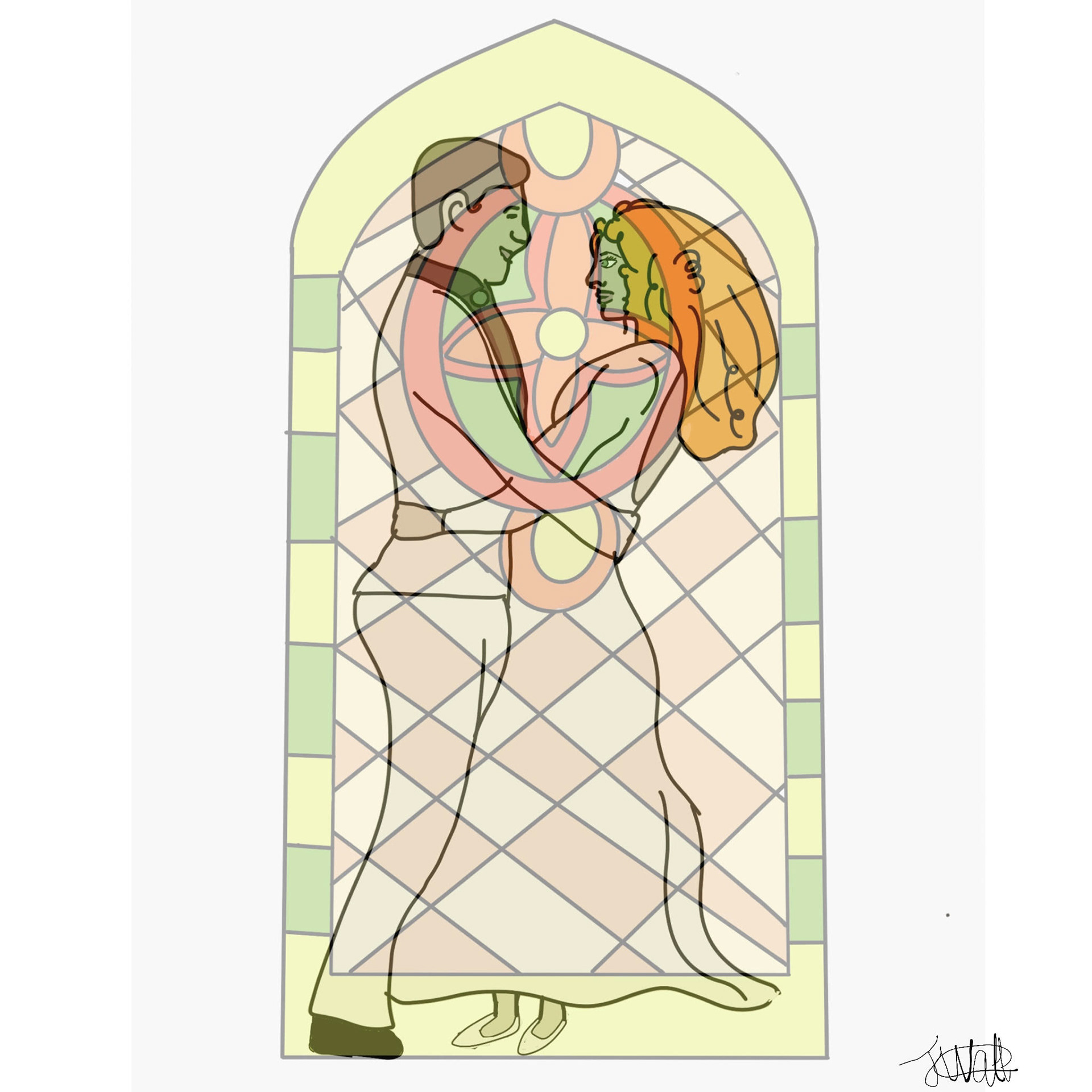
In all white, Wendell’s wife stepped forward, the music rising back up to a quick tempo; Wendell was up, almost immediately in sprint, ignoring sweat on his forehead, rushing past blurry students and faculty to the center of the room. Her dress barely edged the floor, perfect; her hair, as thick and curled as it ever had been, floated down and behind her shoulders, exposed as open caskets. Her eyes were a green dragon’s, from before anyone in the room had ever been born, before Saint Francis, somewhere where dust and rip currents weren’t words or ideas, and those eyes, sweet as any ounce of love, would outlive everyone, too. Through tears, Wendell reached for his wife, and when she took his hand, miraculously, they started to spin; together again, they spun and spun and spun so much that they giggled and nearly fell, heads rested in-between shoulders and necks, he whispering small apologies when he stepped on her toes, she assuring him with nods and looks and reminders that she’s okay and he’s okay and will be okay, and in between the colors of the room, Wendell and his wife, in all white, underneath a heavenly light, danced to their Irish song.
About the author:
Will Gordon is a writer and English teacher in Asheville, North Carolina. He recently acquired his MFA from the Vermont College of Fine Arts. Outside of writing, he enjoys time with his friends and family, golf (especially with his dad), and reading.