Art by Nadia Uddin
When Tansy Became Art
by Natascha Holenstein
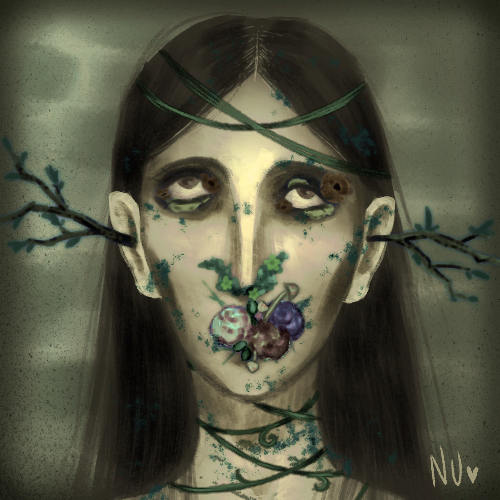
That girl, the one seated against the wall of the old church, is a work of art. She leans against the cracked stone, draped in the gown of chiffon that she wore when she became. Her skin is porcelain pale, and the delicate pink she painted her nails has been chipped away by the elements. She is the living dead. Her heart does not beat but her body exudes life.
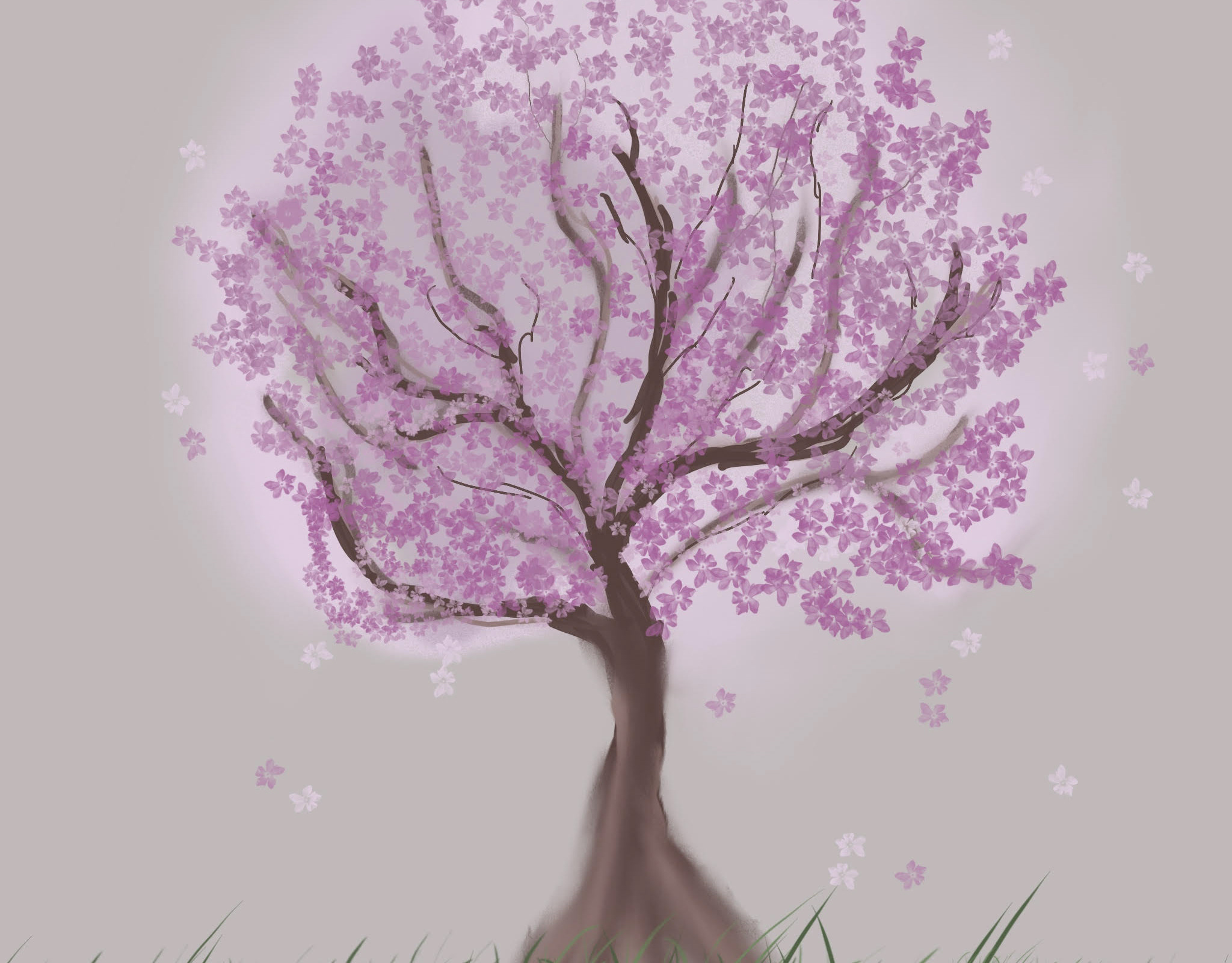
From her mouth burst wildflowers and mushrooms and tiny blades of grass.
From her ears stretch branches that curve towards the sun with leaves that kiss the autumn air.
From her nose emerges sourgrass, those stems we used to chew on when we were girls together.
The mahogany of her eyes peeks out from between her lids, peeled open by fungi and poppies.
And from every crevice grow vines, wandering and reaching, curling around her limbs, decorating her collarbones. She is quite the attraction. Life persevering, death finite, a beauty, a horror. People come from all around the world to see her.
But in the end, she is my sister, and she is dead.
I try not to pass by her during the day. I normally come in the dead of night when the only one to witness us is the moon. Just like when we were girls, laying on the grass and trading wishes under her glow. But she sits only a few blocks from our house, and I can’t bring myself to move away.
I don’t have to try that hard to avoid seeing her today, there is a huge crowd of people blocking my view as usual. They pull out their iPhones and Nikons to snap photos. They steal my sister away in a split second and carry her in their pockets. Maybe they pull her out on holidays to show off her corpse to their families and speculate tragic backstories for the portrait of a dead girl. I stare at them with the hope that they feel my ire as I feel it (simmering coals that I fuel with unspoken words), and then I chastise myself for being cruel. This is what she intended after all.
They peer at her pale body, passing their cameras to friends so they can pose next to her. She emerges and disappears in slivers between moving bodies. An old couple stops me holding a fancy camera, faces worn and sincere.
“Would you be able to take a quick picture for us?” the woman asks, preemptively placing her camera in my hands and I grab it reflexively.
I look into her eyes and gnaw at the inside of my cheeks. My face grows hot and I feel blood pulsing relentlessly against my skull. God, I want to scream. I open my mouth to say something snappy, and then close it. My sister always told me I was too shy. She ran headfirst into raging ocean waves and snuck candy bars into her pockets at the gas station while I lingered at her heels, biting my tongue. I look at her now, almost expecting her to get up and speak for me.
A small breath leaves my mouth, immediately disappearing with the breeze. I let go of the camera and walk away.
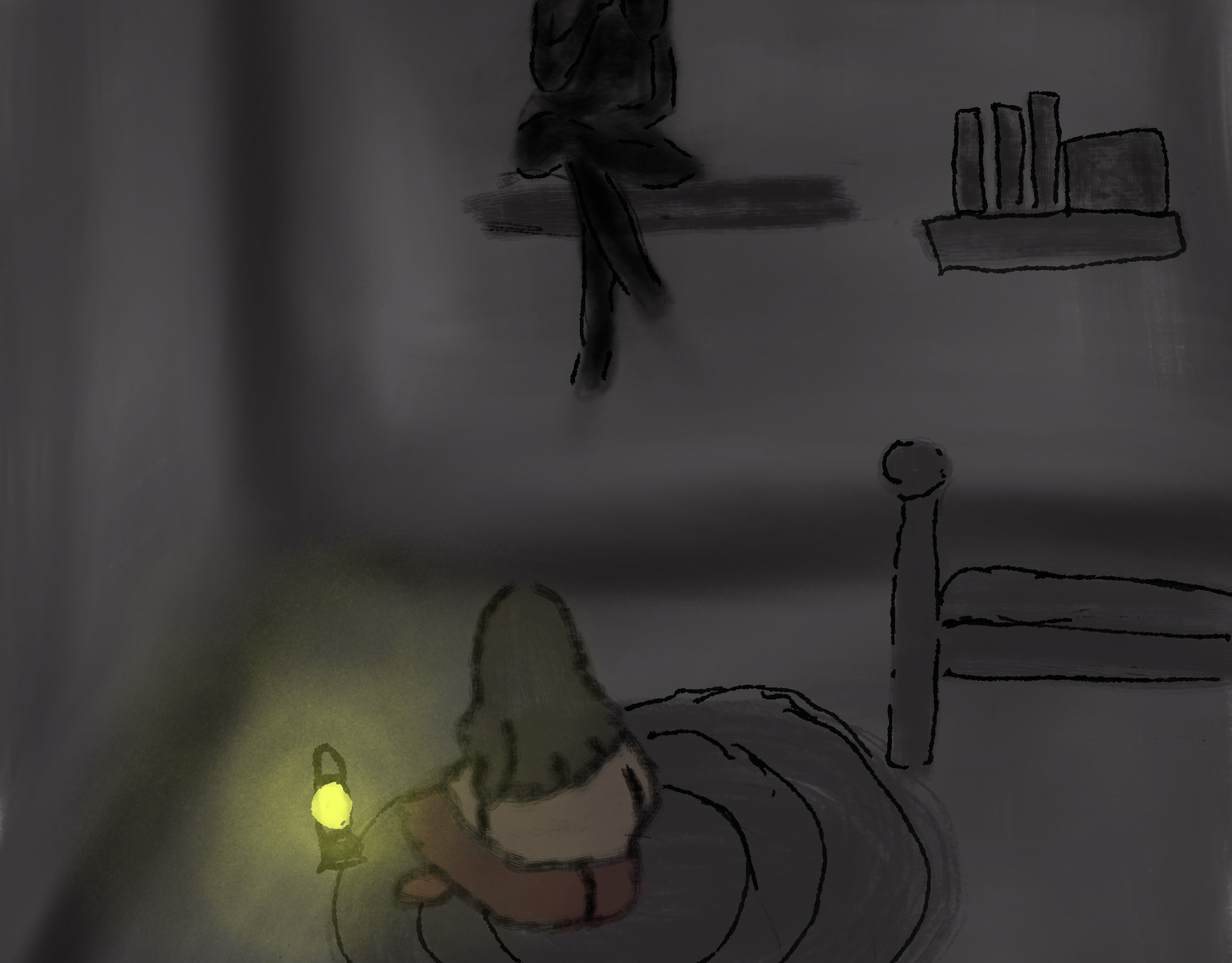
After midnight when the moon is bright, I leave my house, careful not to wake my parents as I crawl out of my bedroom window to meet my sister. I arrive at the church and settle down next to her, collapsing against the stone.
“Hi Tansy,” I murmur to her. “Busy day you had, huh?”
I readjust her leaves, ruffled by the hands of visitors. I smooth the fabric of her dress and pull out a comb to gently brush her hair, careful not to pull too hard since it’s brittle and falls out easily. I chew on the thought that this is what she wanted for herself, and I have the urge to spit it back in her face. I’m acutely aware of the plaque about her head detailing a description of her work. I take care to keep my head facing down.
Looking at her again, poised and blooming, I want to rip the branches from her ears, to pluck the petals spilling from her eyes. My cheeks burn against the cool night.
A renowned experimental art gallery bought her shortly after she died, put her up for auction as permitted in her will. She is owned. I’ve read the reviews written by art critics when I can’t sleep. They always call her death a sacrifice, a life sacrificed for art. As if the art she made was worth more than her life. No one calls it suicide. But is that not what it was? She sat against this old stone wall, and she let herself die. No one truly knows how; by the time she was found dead, vines had already started to emerge from her mouth and creep their way down her limbs. The note she left was released to the public, and everyone respected her wishes to be left here. Her wish to become a work of art herself. Can I blame her? She was never a happy person. I don’t know if sorrow followed her or if she followed sorrow, but either way she clung desperately onto its waist, and it led her somewhere I couldn’t follow. She painted illegal murals in the dead of night and crafted sculptures out of discarded belongings, she twisted the physical into something mystical. I can’t pretend like I understood any of it. Lord knows I tried to. Because if I didn’t understand her art, did I ever understand her? Nothing gave her a drop of meaning from it all but art.
“Not even me?” I ask her now. I feel the soft edges of leaves tickling my cheeks. Her scent is rotten woven together with the sweetness from flora. “Was it worth it?”
This is what we do at night. I ask her questions which I beg to hear the answers to, and her mouth doesn’t even quiver.
“Maybe we aren’t that much different now from when we were both alive.” The words leave my mouth in a dry chuckle heard only by the crescent moon, tucked behind a cloud.
I press myself against her, rest my head on her shoulder and curl my torso against hers. Maybe if I stay here long enough, maybe if I erase my mind and think of only immortality I can become as well. Flowers would sprout from my ears and weave through my hair while blueberries would grow from my mouth to feed passersby. I sit still and willful, and I remain alive. The knowledge that she will always grow beyond me presses against my eyes, settles on my tongue. Droplets fall down my cheeks, watering her blossoms. The edges of sunlight tremble on the horizon. I leave my sister to her art.
It’s a week later and I continue to drag myself from home to work to the church. I move through the days in a thick fog and sleep around three hours every night. I find it hard to eat, and I feel my body shrinking within the folds of polyester. My parents yell at me to do something with myself. Today it has been a year since my sister sat against that church wall and died. It’s on this day that I wake up at noon with the same incessant thrumming that kept my eyes open at five in the morning.
I have no idea what to do with myself, so I walk. I walk and walk through my town, along the river, between shops, anywhere but where her corpse sits, growing. I intentionally left today free so that I could grieve in peace, but I now realize that I have nothing to occupy my body and mind, and I’m left alone with thoughts clawing against the walls of my skull.
The more I walk the faster my heart rate quickens, and I feel myself getting more worked up by the minute, but I can’t be still. Buildings pass me, collapsing into each other in waves of gray. The clawing starts to itch, and it heats my chest, eating away at my lungs. I make an unplanned turn and observe my thoughts as some faraway thing. People are phantoms and I walk through them. My breath hitches as I see my sister’s corpse sitting mere feet away. All roads lead back to her.
As I stare at her festering body, half-thoughts take some kind of warped shape. I stare with poison dripping out of my eyes at the crowd, all these people admiring her beauty. How could she compare, withered in death, to when she was soaked in life, blood reddening her pale cheeks, skin at the corner of her eyes crinkling as she smiled.
And how dare she.
How could she be so selfish as to throw herself headfirst into death, leaving me here? I hear my sister leave through the front door, feet sturdy on her skateboard, and I cry as she goes. I am seven years old. It’s not fair! I cry to my parents. And as I look at her, flowers emerging from her eyes, green leaves bursting from her mouth, I am sick of her. I’m too young to follow her without an adult. Tears heat my face and all I can say is, It’s not fair, it’s not fair over and over. My body is colliding with other bodies, and I trip over my feet before I realize that I’m running. Everything melts together.
“It’s not fair,” I hear myself mumble. When a jolt of pain shoots through my knee, I’m nineteen years old and I’m kneeling in front of my sister’s corpse. The flowers growing from her are like watercolor miracles, fairytale mushrooms, leaves daintily curled, and it’s fucking infuriating how perfect she looks. My sister is teenage angst epitomized. My parents ask her to sit at the dinner table with the family and she screams and screams, nobody understands me! How old am I? Rage is bursting out of every crevice of my body, so ugly and horrid compared to the flora bursting from her. In her anger she tells me she hates me. I wish I was an only child! Is this ire only, knotted in my chest, or is it something more? Raspberries have started to prickle in her hair- why didn’t I notice them before? My sister’s eyes in death look the same as in life. I wish the moon was out to tether us once again. Bursting with a luscious red and a light coating of dust. At midnight I hear her sobbing and banging her head against the wall and the next day she has stitches. My parents whisper, the children’s psychiatric ward has an open bed. A minute breeze drifts, slightly shifting the clouds and I find my hands in my sisters’ chest.
Why are my hands shoved into my sister’s corpse? Either way they are pulling her apart and I gag when I come to but I don’t stop. In death her skin is surprisingly soft and easy to pull apart, but it takes effort. And it feels good. God, giving in feels so good and the release blinds me in ecstacy. I’m grunting and panting like an animal. Breaths that tear through my body as I destroy, ripping off her skin. I tear flowers and plants from her ears and mouth, pulling out their roots and crushing them in my hands. I’m here again, the act grounds me. I am conscious of indulging in the physical sensation of destroying the delicate. The euphoria of demolition marries my rage, and it is all encompassing. I pound my fists against her with something far beyond anger.
My throat is raw from screaming. I shut my eyes, unwilling to endure the outcome, but the truth tickles my skin. The feeling won’t go away, so insistent. I open my eyes. I look down and lurch backwards as I realize there are maggots, beetles, millipedes crawling up my limbs. Shiny black shells and blurs of little legs. I scream and scream and try to shake them off me. Where did they come from? Cries are emerging from the crowd behind me (my God there is a crowd behind me) and I turn around. But their eyes aren’t on me. They’re on my sister.
I turn back and look at what I have done. My sister is gaping open from where I’ve torn her apart and from her decayed insides crawl out hundreds of insects. Her organs are coated with dirt and something black and green. I shift a bit closer and see mold and puss coating her bones. I retch right there on the street next to her corpse. The screams of the crowd fade out as they run away from the scene. I just stare. At her disfigured dreams decorated with rose petals. I ignore the insects still crawling up my legs.
I remain. I remain sat there stunned and unmoving. Horrible thoughts—is she mine now?
For the first time in years, I look up at the plaque on the wall above her head. It reads:
Tansy Toth
If I Cannot Live, I Will Give Life, 2018
The following description is the artist’s note written by Tansy Toth before she died:
This work makes use of nature to create spectacle. There are no artistic mediums used other than my body and nature. I will create this piece embracing that I will die and knowing that it will be worth it if I can dedicate my life to the creation of art and to the creation of new life.
I carry just one regret, that we can whisper to the moon together no more. Let my wishes disappear and let yours flourish.
About the author:
Natascha Holenstein is a writer from the California Bay Area who studied English literature and linguistics. She is currently the nonfiction editor for the literary journal Rawhead. In her work, she aims to always dig deeper and unearth both the beautiful and grotesque. She is also a contemporary, ballet, and tap dancer.