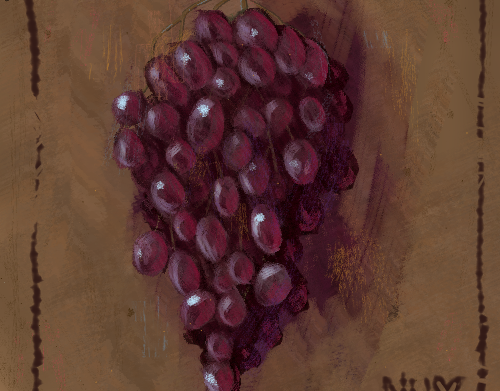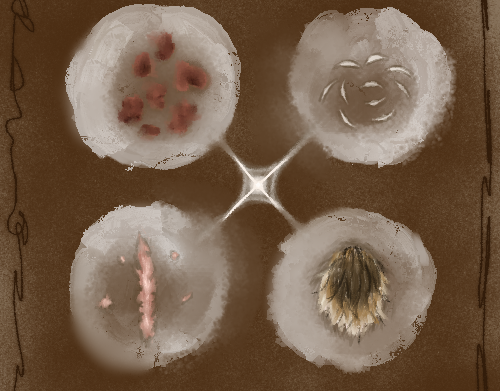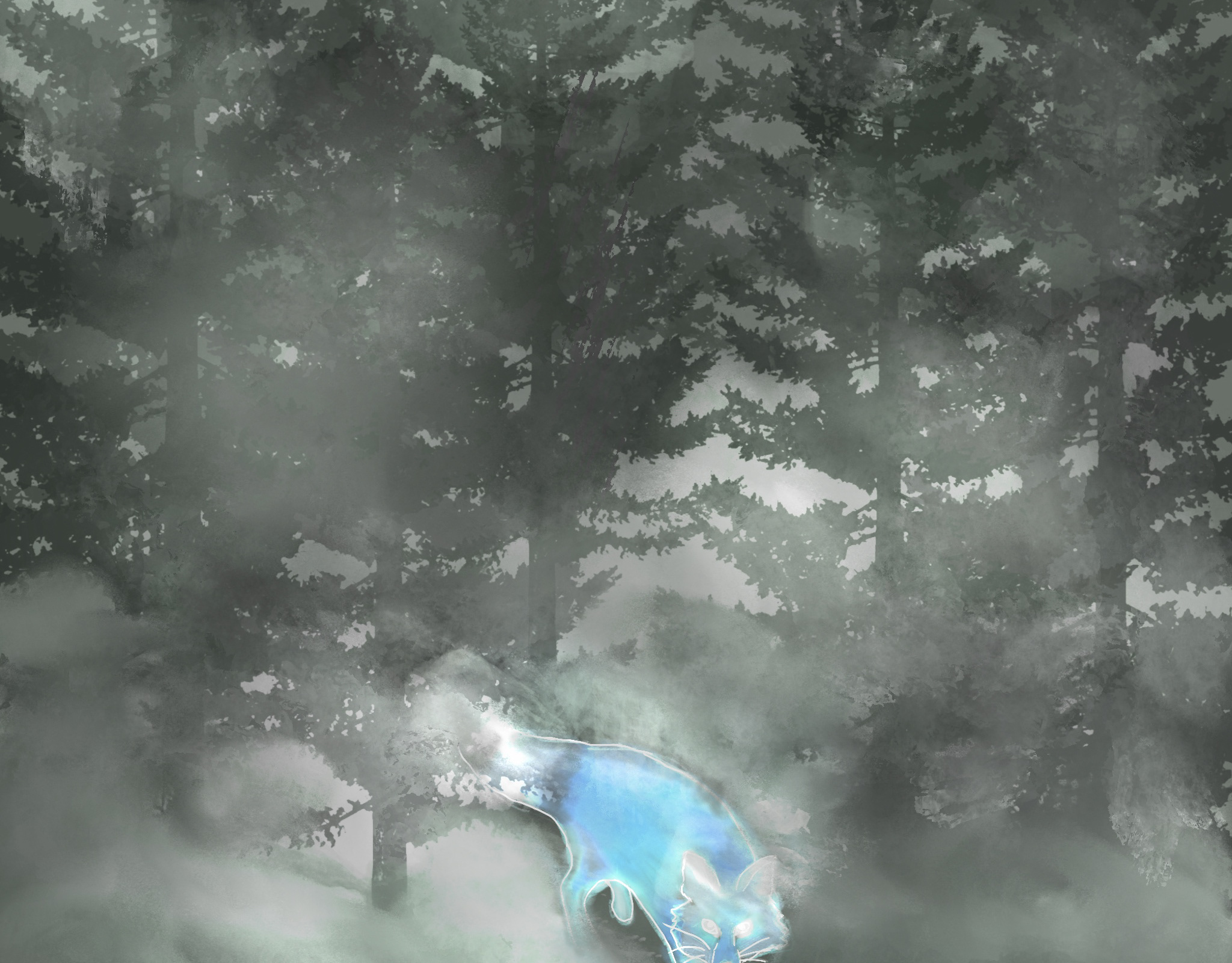
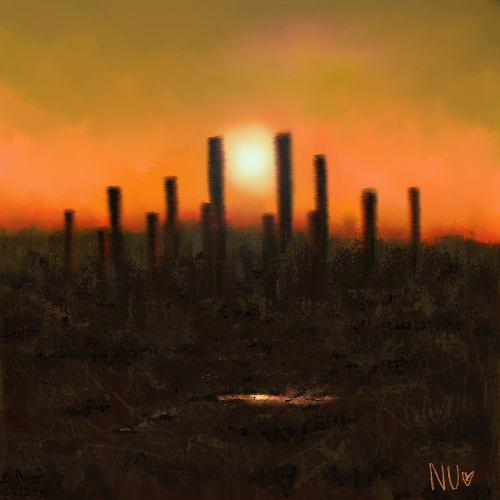
Art by Nadia Uddin
The Ceremony
by Lauren du Plessis
Daybreak
The bright morning sends insects through my skin. They crinkle over each other, feet scratching my insides. I slept wrong, my head angled to the west—opening the door in my neck where the spirits get in.
I yowl in the direction of the light, and Alder’s shape lumbers into view. The moment she eases me up, my chest billows with the opening of wing cases, and I hear myself gasp. Most of the spirits take flight at the nape of my neck and leave through my crown.
Are you ready? Alder rubs my arm.
I sign with my free hand, the other braced against the bed frame. She signals in reply, and crosses the room to arrange my clothing.
Now the insects are quietening, I try to connect with my feet. I press each toe to firm soil. My body is slow. When I lean forward to gather myself up, my growing belly brushes the tops of my thighs, hairs interlocking, gems of sweat merging.
I'm heavy today.
Alder nods patiently. Of course. Your body knows what day it is.
The baby does too. It rolls in my stomach as I drop weight onto my feet. Perhaps the spirits woke it. I cup my hand underneath the bump, patting and cooing. Shh, baby. Save your strength for later.
The hide from my bed is sweat-soaked. I hang it, before shuffling around the firepit to the trunk where Alder has laid everything out.
Protective cloth strips are wrapped around my torso. Next, a pale, yellow top knotted from coarse fibre, which falls neatly over the baby. Trousers which cling in the early morning warmth. Light summer boots tied with thrice-wound leather.
While Alder works, I trace the ridged curves of the boar teeth which are soon to frame my head like a grin. They hang from beaded, sinewy braids around the main bulk of my headdress: a hollowed Red Deer face. Tall antlers protrude from the forehead. Polished flint eyes watch me.
It’s fresh: Father killed it a quarter moon-cycle ago. Brought it to me before they skinned it for the ceremony and divided the meat for drying. Its antlers were coated in velvet back then, and tickled when I ran my thumb over them. I had turned my head to consult the spirits. Yes, they replied, you may have him.
Across my breast Alder hangs the other teeth in a thoughtful zigzag: aurochs, boar, and deer. Finally, she lifts the headdress high above me, so the beads rattle and clink. My neck throbs in anticipation. The ceremony happens only once a year, but on the longest day. The longest in sunlight, but also the longest in feeling. This is the day when my body and its knowledge of time come undone.
Alder releases the weight, and everything compresses as if I am being driven into the floor. The insects that left return immediately, burrowing into my extremities.
It’s difficult to see out without tilting my entire body, so I wait in the dark to adjust. I imagine the villagers rushing beyond my doorway, gathering food and water for the journey. The children bickering over which necklace they’ll wear. Father placing an offering for Mother at the burial ground.
Stone cools my eastern hand and I flinch. Alder closes my fingers around whatever she placed there.
For protection, she explains.
In ten midsummers, she has never given me a charm. My voice comes out muffled from under the headdress. Why?
Alder takes the stone back to affix it above my heart. Then she taps my chin, and I lean back one vertebra at a time. She thumbs red ochre down my face and I open my palms to receive it there, too. I am ready.
When Alder looks back at me from the entranceway, adorned in the remains of animals and plants, and aromatic with carcass and soil, her hands ball into fists.
What’s wrong?
She waves her hand and leaves. The weight of the headdress pushes me back into darkness.
Far-off birdsong: that’s all I’m left with. I hum, tapping my fingertips around the baby. I don’t know whether I’m trying to soothe it, or myself. But the spirits beetle at the edges of my mind, warning of a shift.
Rising
When I was young, Alder told me Mother got the gnats and mites first too. Then they attracted others. Crawlers, padders, gallopers, and thunderers. Our chosen spirit came last. The deer I now wear atop my body.
Some full moons ago, our younger hunters went patrolling and cornered a Red Deer. They howled back through the village with a smattering of blood—my cousin had been gored. He died in my hut, me cradling his head so he wouldn’t be afraid. His mother still walks slower, like he grabs at her heels from underground. Not revenge, Father said when he presented me with my headdress many days later, balance.
We are leaving, he tells me now. I jolt into the present. The sun heaves itself over the horizon, knowing it too has a long day ahead.
Suddenly I’m in the air, until my feet hit woven reeds. I sit. An aunt spent the past days tying planks together and stuffing the recess with luxuriant bedding, so I can sit or even lie in this year’s carry-box. I sign a thanks, already tired from all the movement.
Two of my uncles confirm their presence and we lurch into a steady pace, to joyous goodbye hoots from the elder folk.
We pass the thatch of houses, the knoll of the burial ground, and the wall. I rarely leave this enclosure, and the thought of venturing out into the wild with the animals and the plants—even if I don’t walk it—invites more spirits to creep in. Father hands me a wad of meat to keep my strength up. Flesh clings to gum, and through it I taste the earthy flavour of grass. I eat the deer, which eats grass, which someday will reclaim me: a forever cycle. It is comforting.
The bank shifts over time, but you know when you reach the marsh boundary: the ground softening then spurting like a pus wound. Without the path it would swallow all who tried to cross. So every few years they refresh the planks. Felled trees whittled to a point are placed in broad cross-shapes, with long boards laid in the meetings.
As we inch onto the first plank, I catch shards of white poking through the wetland plants either side, and I wonder if someone fell in a long time ago, their skeleton reemerging to bask in the lustre of the long sun.
My uncles’ knuckles are stretched thin where they wrap around the carrying bars. We must be heavy—baby, me, and the ripening spirits.
Behind us, the village’s sweetest voices meander through songs, while the children bury offerings in the marsh’s ooze. Pots bob at the surface, but an axehead vanishes quickly. When the sacrifices run out, the singing tapers away. I tune in to the shallow breath of the wind and the march of booted feet.
As the sun climbs highest, my headdress and skull vibrate like one fused thing. I’m lying back, heat blighting my exposed lips, but when I try to lift my arm as a shield I become aware of my numbness.
The change is happening—the reason I cannot walk on foot, the reason my body is so stretched. My job is to bring the animals with us to the circle, to promise the spirits that we will work with them for another year.
It is only a short moment this time. After the bugs have their fill of my fingers and toes, shrews and mice pitter-patter down my back with tiny claws, weasels slink around my joints, and the largest beasts wedge into my ribcage. Boar, aurochs, and of course the deer. There is no space for my lungs. But they let go easily. Later may be different. I shut my eyes and rest.
In the dream world I ebb into the Red Deer’s body, its gait a rock from side to side. Sun and Moon keep guard at opposite ends of the sky. We stride through a wooded area and stop in a glade, fold our legs, and thump into the petals. Stirred-up pollen coats our fur.
A twig snaps. Our ears dart to the East. There is movement in the branches, the sound of hooves. We relax.
Another hind glides to our pool of golden light. It ducks its head to graze, one black eye fixed on our face. We know somehow that this deer is Mother. She nuzzles us with her snout and we sniff the air around her: heat and home.
When I wake I am met by the pitch-dark of the headdress. I gently tilt back, and a bar of orange beams into my vision. Many hours have passed. The breeze whips under my clothing in the gaps, raising goose pimples.
Hello, Alder says.
I met Mother in a dream! The excitement catches in my throat.
Alder threads her hand into mine. Squeezes. What can she see that I can’t? I am about to ask but she speaks again, in a low voice.
We can try to interpret the will of the spirits. The will of the earth. When we think we have an answer, we build walls around it. We create belief. The sun will rise, fish will swim into the nets. But all along, we feel the truth: nature gladly plays with its own rules.
I don’t understand. What rules, Alder?
She knows it is coming. Your mother is reminding us that you too were born of playful rules. Alder pulls my arm to brush something. Feel how the reeds part here? We've arrived. We’ll take you to the circle soon.
Descent
It’s getting hard to remember a moment before I was wearing the headdress. I’m not sure it is a headdress anymore, or an extension of me. The hairs on my arms and legs have grown into wiry fur. My throat swells, aching with animal voices. Father lifts me and staggers.
I’ll be lighter next time, once the baby arrives.
He doesn’t respond, positioning me on the mound that overlooks the timber circle.
All body heat dissipates. I’m alone. With a deep breath I tilt my head back to survey my limited view of the ceremony preparation. I allow myself a quiet sigh.
We erected the circle when my mother was the seer. Fourteen colossal pillars jut from the lakeland, crusted with barnacles. When the sun sets on the longest eve, and rises in the morning, it cuts perfectly between the two tallest pillars. From where I sit, its heat splits me down the middle. Cleaved open like a hazelnut.
On the patch of fertile grass between my dirt mound and the timber circle, people roll out woven mats and unpack food parcels. A fire leaps up and the air pops with smoke, making my mouth water.
Hungry? Alder asks, sinking into a wide squat. She grabs my western hand and slaps a pack of white fish meat into it.
Why are you and Father acting strangely this year?
We’re nervous, sweet one. It’s strenuous for your body when you’re pregnant.
That’s not it, I say.
Alder shrugs and looks back out toward the others, who have found a rhythm of filling their hands and mouths, their chatter rising like the lake surface turning to steam.
I try again. I became seer when I began bleeding. But after Mother died, and before I bled, did we travel to another town for ceremonies? Can only women become spirit seers then?
Of course not, she says, we've had many male seers.
So why did we leave a gap? Why couldn’t one of my brothers take over?
Alder frowns. You were special. The elders felt we should wait, to see how your power grew.
I lower the fish to my lap and stretch to find Alder’s arm. Skin as light as butterfly wings. I don’t often think about how old Alder is. How she saw Mother grow up, and create me, and die.
What told you I was special?
When I get no reply I am tempted to lift my headdress and examine her expression. But she senses my movement before my hand can twitch, pulls me closer.
You were large.
Large? Nobody has ever told me about my birth before. Not even the fact that I’d been large.
She goes on. Long legged. Curved spine. Hard to birth.
That’s why Mother died?
No. Her grip tightens, nails sharp. Your mother was strong. But you…well, it seemed as if you wanted her strength. And she gave it willingly. We were sad, but a few weeks later I understood what had happened, and the elders agreed.
What? What happened?
You witnessed the spirits as a baby. You arched and turned purple. We thought your mother was claiming you back. You made no sound. But then it stopped, and you survived. I saw how powerful you were. We could only conclude that your mother gave you everything: all of her strength along with your own.
My insides go dead quiet. I try to sit tall, like the deer I am supposed to be.
You think my baby will take all of my power too, I say.
Alder says nothing, yet even that hits me like a stone pelted from the sky. I always knew I was the reason Mother died. And perhaps I had always known I would not survive childbirth, either.
This is my final ceremony, I say, and the weakness sours my mouth.
What do you feel?
All that answers is the urge to bellow until my throat gives out.
Waning
The dusk is red, broken up by the shadowy bodies of my friends and family, who now surround me. When their voices calm to a murmur, I hear Father’s voice from behind.
We are here to continue the work: what has always been done, and forever will be done.
As a child I learned those words too, believing one day — when my child took over my seer duty — I might recite them. When he’s done, I feel a tap on my hand.
I will talk to the spirits, I say, and turn my neck, opening the gate.
Nothing. I stretch my fingers and toes, find the space around me, ensure I am safe if the contact throws me onto my back.
But the deer in my mind merely grazes.
Red Deer, I call. It chews, lower jaw circling over and over.
I wait for the tingle, itch, heat, lights in my eyes. My wildness only I can know. But it's not coming.
I grunt, rolling my abdomen forward and back, feeling the baby press on my thighs. But the spirits huddle in my margins. My heart thunders with rage. Gurgles erupt through my tonsils. Ahead of us, the sun sits low on the horizon, its light spearing my forehead, waiting for me before it sets.
Are the spirits angry? I hear a small cousin ask.
The mother responds instinctively. Just wait.
I allow my voice to die away and find calm. The truth dawns on me: they cannot see inside me. I can choose to pretend.
The sun cuts in half, rays exploding against the clouds. I begin to mimic my body’s learned movement from ten years of ceremonies. I gasp, wriggle as if the insects are needling my limbs. I shudder with all the energy I can draw, then go still.
There is total silence. I lick away the sweat dripping from my nose onto my lips.
The spirits are pleased, I say.
Everyone cheers. Feet thunder around my body, rush down the hill to the circle. I cannot see, but I imagine hands touching pillars and tears of love streaking faces.
The dancing and singing will last for hours. I am allowed to rest after the ceremony. I still haven’t told anyone. Perhaps I’ll take my act to the grave with me.
Father heaves me to my carry-box and helps me to lie back. Then, he lifts the deer headdress.
The sky is blue. The stars are bright. My hair is suckered to my face and my skin feels as if it is made from wind.
Well done, Father says, we love you. Then he leaves.
It’s the first time all day that I have my full senses. Air whistling through reeds, fish blowing bubbles and popping them, the sky deepening ever more blue. I have lied, but it is done. I wipe moisture from everywhere I can reach, then close my eyes.
And blink them open again.
There is a spiral in the sky. Burning orange.
My body is too exhausted to lift myself to my feet, and tell the others the spirits are talking.
The glow moves with my eyeballs, a filmy layer over the world. The deer is with me at last. I clasp my hands around my elbows.
The spirits are so loud I am sure I will vomit. Red and orange blot my vision, the sky moves like an ocean. Animals roar through marrow, echoing through any spaces in my body. Both hands now grip the skin of my gut, where I feel the baby kick. I am sure what is happening inside me is also flowing into my child. My noises are strangled.
It ends. My breathing is jagged. I search the bump. Baby, where are you? Baby?
It kicks. Baby, you’re alive. I smile. You are stronger than me.
Beyond my carry-box, my family revels in fireglow. The sun will return soon, on the midcycle day, a day closer to my baby’s birth.
I watch them from the shadows. In my mind, the Red Deer’s ears rotate, waiting on an ever-present danger.
About the author:
Lauren du Plessis is a British writer of speculative, folkloric, and weird fiction with a literary leaning. Her short stories have appeared in Litro and Mslexia among others. She works across marketing and narrative design. Tender, her debut novel, was published by Influx Press in 2025. Instagram: @laurenduplessis.author