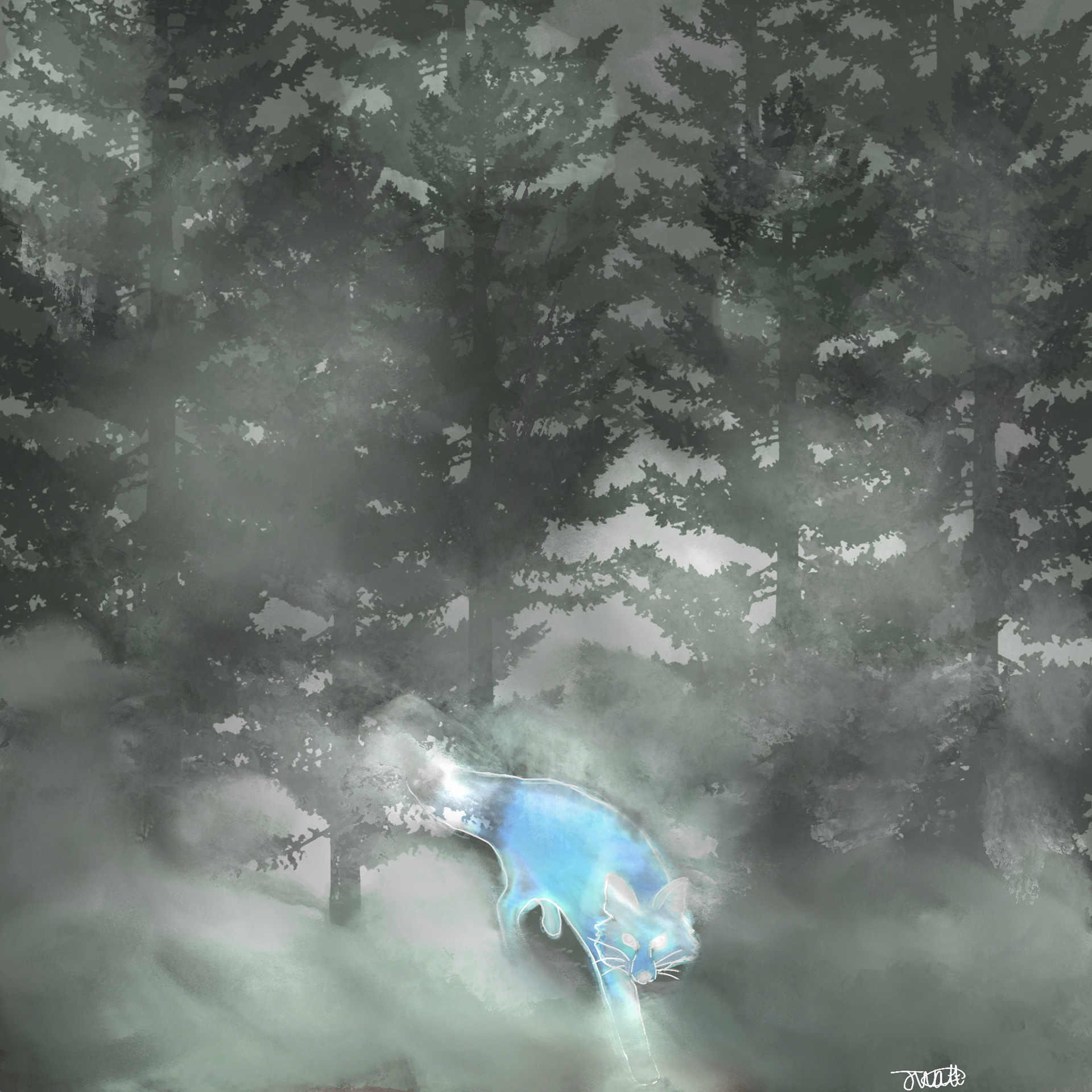
Art by Jen Watt
The Creaking Bed
by PR Woods
Every time he lay down in his bed, it creaked.
He completed his evening routine with exactitude: putting on the striped silk pyjamas he had laid out in the morning – a fresh pair every day. A skinless cocoa. Cleaning his 31 teeth. He checked the cooker (off), the doors front and back (locked), the fire alarm (flashing, correct). He tested the carbon monoxide monitor (one long beep followed by three short ones; all in order) to ensure that if he died in his sleep, it would not be from carbon monoxide poisoning.
He got into bed, having laid the draught excluder (if he died in his sleep, it would not be from draughts) almost tenderly along the bottom of the bedroom door.
All was tranquil.
Nothing stirred.
The only movement was the faint, but certain, beating of his heart.
He read thirty pages of his novel. Always thirty, even if it meant stopping in mid-sentence or even mid-word if the typesetters had been careless with their crossovers.
He sank his cheek into the plumped duck feather pillow and inhaled only his fair share of the world’s oxygen.
Sleep usually came quickly, and without incident. If he dreamed, he did not remember those dreams. If he had concerns, inconsequential or existential, he wrote them in a navy moleskin notebook left on his bedside table for this purpose. The pages, soft and finely dusted, like the cheek of a grandmother held up for a farewell kiss, were largely blank.
After about eight minutes, he was surprised to realise he was not asleep. His mind steadily worked through the possible reasons for the delay.
He was not aroused.
He was not worried.
He had not forgotten to do something important.
He sat up in horror, and the bed quietly answered him. This, perhaps, is how dementia begins, he thought: a disquiet in the darkness, a disturbance in the silence. Then comes the loss of the word for a particular colour or failing to name a familiar bird. A face without cues. A fruit bowl full of alien objects. He tried to reassure himself by murmuring how velcro works. Inspired by a burdock burr, velcro is a design of hooks and loops, usually built in nylon. It is a fusion of the French words for velvet – velours, and hook – crochet. It is difficult to repair. Satisfied with this unchanging knowledge, a knowledge that fused snippets of materials and language and technology, he turned his other cheek to the pillow and sank down. If he was to develop dementia, it would not be tonight.
Only a fool stamps on a puffball to kill it. When you tread on a puffball, you do not destroy it but rather spread it; like Abraham you bless it with a thousand spore-children. And when a foolish man dispels sound with thought, the vibrations return with vehemence when the thought is concluded.
Still no sleep. The man propped himself up on his elbow, lifting his ear from the pillow, and listened.
First, there were human noises. His own heart, still behaving impeccably. A gentle digestive groan. The inane chatter of the couple in the flat downstairs.
Then, his ears picked up the noises of modern existence. The irritating yet essential hum of the fridge. Two clocks chasing each other every passing second with a most unpleasant syncopation.
Outside, in the street below, cars made unembarrassed noises of illegal horns, engines spluttering, doors slamming.
No, nothing unusual there.
He sank his head yet again into its night-time cloud of cotton, but this time rested the back of his head on the pillow, keeping his ears alert as a hungry owl, the way he had lain as a child, staring up at the blankness of sky or ceiling, and wondering why, one day, his mother stopped coming to fondle his pixie ears, and never returned.
Within moments he was deeply, restfully, almost perfectly asleep.
Twenty-three and a half hours later, he found the entire situation repeated with circadian certainty.
There was one significant difference.
The moleskin notebook had a word written in sentence case on the thirteenth leaf.
Creak.
Younger than the word by only a few seconds were two heavily drawn lines under the word, denting the paper like a scratch. The neat parallelism of the lines was so pleasing to him that it almost soothed the nervous irritation of the word above. He resisted the urge to link the two underscores with two shorter lines to create a parallelogram, knowing from harsh experience that it would ruin everything.
The thought that he might have to buy a new bed when this one was in almost flawless working order was repulsive to him. Yet this bed creaked, which was an agony. And there came to him a doubt, an ever-present-yet-tiny-as-a-copepod concern. What if the new bed creaked as well? What if the creaking was not in his bed, but in his head? Ever since he had read Aubade as a too-young child, he had been struck by the idea that there were millions of dead people standing around him and laughing, or simply relishing their knowledge of what happens when you die, something the living can never know.
Never. Know.
And he imagined all those dead saying, “Aha! That’s how it is. All that worry for nothing.” Sometimes he felt them, slinking around tree trunks or standing alongside him at bus stops and zebra crossings. We know. We know. We know. By the time we know the truth, it will be too late to change our minds.
As always, he sought solace in practicalities. He took apart the bed, testing every join for weaknesses, teasing out screws and dusting the miniscule speck of sawdust with a tiny brush. He stared at the frame as if it was a live animal to beware. His eyes bored into it like a laser, as if by synaesthesia he could see what was making the creaking sound. He stripped the bed down and washed all the bedding, letting it whip itself dry on the line. He ironed it twice and smoothed it free of creases as he pulled it taut and comfortable over the regularly turned mattress. He checked all the skirting boards in his bedroom, all the cornicing and the wardrobe for any sign of mice or spiders or creatures of any kind whose movements could cause a creak. There was no sign of any life, not even a dust mite. As he worked, his heart cheered at the prospect of a peaceful night.
He did not have a peaceful night.
The Monday after the creaks began, the man went to the ERSAL yard – Eastfield Rolling Stock And Locomotive, a place where he had once been happy.
Ever since he was a boy, the man knew he did not really belong among humans. He largely understood people, yet kept them at a distance. People were like balloons filled with different gases; some rose high, and lived long, and were a distant, colourful presence. Some skulked along, barely lifting off the ground, ready to be blown off course by the softest of breezes. Eventually, of course, all balloons deflate. The man knew he was a balloon too, but a different colour, on a different trajectory. Humans like him – laconic, comforted by routine, irritated by too-short scenes on television, saddened by easily reparable brokenness in the material world – were rare.
At the ERSAL yard, he had found some of those rare humans. A group of six men and one woman, sharing a deep knowledge of steam engines, mainly locomotives. They wore the same paint-splattered cerulean overalls, with streaky oil marks where hands had been wiped on the trousers. He knew them all by name, and they did not chat or show any interest in each other’s lives. They simply said, “Need a hand with that?” or, “Try the 7-inch” or, “She’s been playing up.” Delightful sentences without ambiguity or alarm.
The yard had a cat, a sooty black feline with slick fur that blended with the oils, who hissed and spat at the soldering irons and slept on the engines. He didn’t like or dislike the cat, yet he looked for her, and shooed her away when she got too close to danger, knowing that cats have the same number of lives as the rest of us.
He hadn’t been back to the ERSAL yard for many months because a man had died there in an accident, and that made him sad. However, he knew that if anything could give him an answer to the creaking bed, it would be the yard. He rolled one side of the doors open, inching the concertina into itself. The smell hit him. The smoke and dust, and the glazed currant buns someone had fetched from the workers’ cafe on the high road; strong tea; oil old and new; the uncomfortable, necessary smell of paint. It was what he imagined Victorians must have smelt like. He looked up and, yes, his overalls were hanging on the hook where they should be.
“Morning,” a voice said. “Old Sal is fixed now, whistles like an angel, but Hardy’s croaking like a twenty-a-day granny.”
Through the gap in the doors, a perfect rectangle of sunlight illuminated the floor of the yard.
“I have to see to something,” he said. “Are the samples still hanging in the usual place?”
“They are,” said the other man, wiping his nose with a cloth.
Moments later, as our man was gently bending balsa, cedar and walnut, his ear inclined towards the tell-tale lines in the wood, the other man came over with a cup of tea.
“Good to have you back,” he said, and went away.
The wood at ERSAL ranged from splintery scraps scattered on the floor to great hulks of plywood, as well as storage boxes and working models of pistons and crankshafts. Wood was used for tool handles and axles, for platforms and temporary roofs. Sometimes it acted as the younger brother of metal, holding things in place, testing a mechanism, or supporting a half-finished piece. The man ran his expert fingers over wood treated and varnished, burnished or sandpapered. He lay planks across the gap between the work stations, placed iron weights on the top, and measured the bulge. The wood was like the fingers of a sprinter at the start of a race, holding its maximum level of weight and expectation. But he could not make them creak. Every sample was utterly, impeccably silent.
At midnight, the man was awake and motionless, yet still the creaks thundered in his ears like a waterfall. He clutched the sides of his Norfolk oak bed frame, willing it to stop. Tears fell from his eyes down into his ears. He wanted that woman he had known as a mother to come back and fondle his pixie ears, and tell him everything would be OK.
He folded his arms over his ears so that they made the shape of grasshopper legs. Yet the creaking was within him now. It was the creaking of every branch of Birnam wood as it neared Dunsinane; the creaking of the 120 million bones of the world’s octogenarians; the creaking of an iceberg as it calves from its mother glacier. The creaking would never pause never halt never ease never quieten.
Putting on his slippers and dressing gown, he headed outside, placing his sharpest knife, wrapped in a clean tea towel, deep into the gown’s pockets. Foxes warily crossed his path. Finally he reached the forest, where the trees sang to him in a mycorrhizal choir. He lay, like an artist’s muse, across the lateral roots of a Maple, and neatly performed his task. As blood flowed from the holes where his ears had been, the creaking finally stopped.
About the author:
PR Woods has been published by Adda, East of the Web, Ellipsis Zine, Fictionable, Globe Soup, Impspired (forthcoming), Litro, the Manchester Review, Reflex Press and Westword (forthcoming). She won the Parracombe Prize 2023 and was shortlisted for the Commonwealth and Mslexia short story competitions 2021. She lives in London, UK.
Find her on Bluesky: profile/pudsk.bsky.social