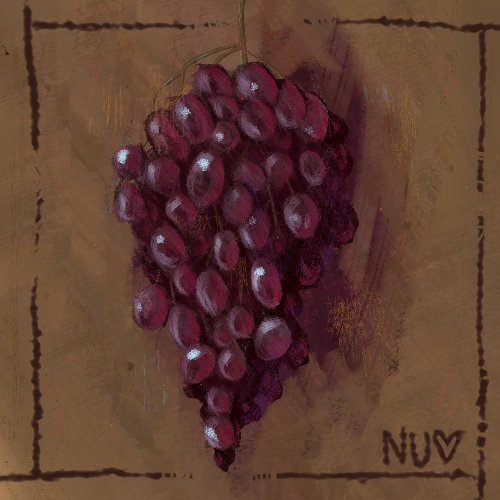
Art by Nadia Uddin
The Painter
by Brie Ward
The Painter found me on the dance floor of a Saint-Tropez nightclub in the dry heat of an August evening. Clad head to toe in white linen, he approached with a leonine gait and bared his bold grin at me in the flashing lights. I found I could not tear my gaze away from his nearly translucent blue eyes, even as he grabbed my hand, pulled me towards him.
“Darling, you must let me capture you.”
His face would never have been familiar amongst the sea of bodies, but his name was enough for me to hear him out. Everyone who wanted to be someone, everyone who was someone, knew him. He had painted actresses, models, princesses, and his portraits had become something to envy, to aspire to. They had been displayed in magazines and in museums, and I, like anyone else, had been drawn in by their magnetic beauty. The Painter didn’t just replicate a likeness. He elevated his muses to true splendor.
“My house is just in La Croix-Valmer,” he continued. “You must come. Let me make you art.”
It was as if he knew I could not say no. The last of my meager savings had been spent on a plane ticket for the opportunities my friend Marie assured me I would find here. I had been sleeping on the armchair in her hotel room for three days with little to show for my efforts but an aching back and an endless hangover. And here he was. An angel with slick platinum hair. Come to change it all.
I had learned to sense a threat long ago. The handsy photographer, the gropey exec, they were all familiar to me now. As close to the man as I was now, I had braced for an unwelcome touch, a lingering look. Neither ever came. Nor was he distracted by any of the beauty around us. I was willing to bet my life that The Painter did not swing my way. In fact, in the time that would follow, I’d become convinced he didn’t swing any way at all. There was nothing he seemed interested in beyond his art. So I went with him.
An hour later, he was leading me through his oceanfront home, chattering about the history of its stuccoed walls. I could hardly hear him, my attention solely on the portraits that covered every inch of the place. Every one was magnificent, and yet, to see them all here together en masse, eyes following us up the stairs and down the hall, made the hairs on the back of my neck rise. The occasional lizard scuttled across the canvases, across the faces frozen in time. I tried not to imagine myself in their place.
He led me out onto the expansive second-floor balcony, with its clay-tiled floor and view of the ocean. It smelled of dust, of rosemary and lavender that must be growing in the yard below, though I had no time to appreciate any of it.
At his instruction, I undressed and climbed atop an ancient-looking wooden table while he set to work. He was a flurry as he made up the scene: placing props, directing poses, setting up his easel. Within minutes, I was the centerpiece of a bacchanalian feast. In one hand, I clutched the edge of a sheet the exact color of the sky as the sun rises; in the other, I dangled a bunch of purple-black grapes just above my breast.
The Painter took his seat before his canvas, laid his eyes upon me, and declared, “Perfection,” in that unplaceable accent of his.
Above us, bats took flight. Scurrying from the dawn. I moved only my eyes to watch them float on the breeze, down towards the ocean.
For hours, we sat in near silence. He with his paints. Me, with my trembling muscles. As many times as I had stood before a camera, to sit in utter stillness for so long was a new and nearly unendurable feat.
Once, my elbow dropped, only by an inch, but he was quick to correct. “Hold still, Habibti,” he cooed.
The longer I stayed, the more the contents of my stomach curdled. As diligently as he worked, he seemed to hardly look at me. Like he had seen all he needed to in the first moments, and needed only his talents from there. Still, he would not allow me to move. I wondered just how many women had sat in my place. Listened to his dove-like voice give reassurance and wondered at the possibilities. Where were they all now? How had they fared in the aftermath of his shining light? It set me on edge.
Only when the sun had fully risen did he release me. My limbs screamed in protest as I gingerly stretched and moved them from their long-held pose. Graciously, he helped me off the table and caught me when I nearly fell, shaky as a newborn doe.
“May I see it?” I asked.
“Oh no, not yet, my dear. I do many drafts before I am done. Something of a perfectionist. I shall send along the final image when it is completed. It will be exquisite, I promise. For now, you will be on your way. I will call you a car.”
I glanced over my shoulder at his waiting easel as he rushed me out the door. Curiosity, a violent itch I could not scratch. The feeling was tempered only by the sudden wave of exhaustion that washed over me. We had worked all night, and the sleeplessness had caught up to me with haste. I let the Painter tuck me into a car, bid him adieu, and promptly slipped into a dreamless slumber, unperturbed by the winding roads back to the city.
In the days that followed, something changed. Marie noticed it first, commenting that the Mediterranean air must agree with me. Staring into the mirror in the hours after, I thought she must be right. I was me, but not me. My skin was warmer, luminescent. My hair was shining and silky to the touch. Even my eyes looked lit from within; two dark, magnetic pools of umber.
The first thing in my inbox when our plane landed back in the States was a scan of the completed portrait from the Painter. I barely recognized it as a picture of myself, but for the features of mine that were so clearly there. The mole beside my nose, my mother’s brow, my father’s mouth. This woman, though—she was Isis, Aphrodite. Painted on a sea of not-quite-black, amongst a sumptuous feast, she lit up the foreground. Bronzed skin, luscious dark curls, a mischievous glint in her eye. It took my breath away.
I wrote back to him a profuse paragraph, gushing over his talents, over the wonder the work had turned out to be. He replied, “Thank you, my dear. In that case, would you consent to it being displayed? There is a darling gallery I work with all the time. I’m sure they’d love to have it.”
There was the chance I had been waiting for. To be a muse, a public one, a chosen one, would open every door there ever was. I knew the names of the women who had preceded me. Faces that had sparked like meteors across the sky, names that had slipped across everyone’s lips. I could be one of them.
I did not send my response right away. Something within me held back. Told me I was not ready. I looked up my predecessors, and drowned myself in their images. The paintings and the thousands of photos that had come after. Strangely, I could find nothing recent of any of them. I suppose that was the nature of a career like ours. In and out with the tide. This is what I would be choosing. To be seen, and then, just as surely, to be forgotten. But I craved the light. So I made my choice.
Within a week, my life was unrecognizable. He had sent the painting to be displayed in Paris. Crowds had gathered to see his new work. Waiting in hours-long lines to stream slowly past the newly unveiled canvas. Articles were published featuring the piece. My Instagram followers steadily ticked up and never really stopped. I grew addicted to the rush of notifications that flooded in each time I posted a picture. My agent fielded calls from far and wide, wanting the time of this yet undiscovered gem of a girl who had caught the eye of the most famous artist in the world. For once, on sets, I was no longer expendable. I had never known how kind industry people could be when they considered you a precious commodity. Taking every job I could get became the norm, and soon I could no longer walk the streets of the city without being stopped every few feet by a fan. It was everything I had prayed for.
Soon, I found I could no longer pass by my own reflection without stopping to look at her. That too-perfect face stared back at me from darkened store windows, strangers’ compact mirrors, and even, once, a fish pond. There was something in her eyes that I was desperate to name. A hint of mischievousness or a tight-lipped facade, a certain otherworldliness that scratched some unreachable part of my mind and would not let me go. Her grip on me verged on the absurd. I was all-too aware of it and still so often unable to pull myself away. I started to worry I’d be hit by a rogue taxi one day, caught in the grasp of my image in another car’s window. Even Marie complained I was useless now. Snapping her fingers in my face when I’d gotten distracted amid a conversation for the umpteenth time. I only felt truly embodied in front of a camera, where she—the other me—could take over, flawless in form, and I could retreat into serenity.
My miracle lasted nearly a month before I woke one morning feeling as though I’d been run over by a train. Muscles aching, limbs fatigued, brain clouded over with fog, I dragged myself out of bed and to the bathroom. With one flick of the light switch, all was revealed.
She was gone. Whatever sheen had cast over me in the preceding weeks had disappeared, and then some. My skin had gone sallow and grey. The youthful plumpness of my cheeks now looked sunken, flesh hanging limply off my skull. My once bright eyes looked jaundiced and ancient. Even my hair, once the trophy of all trophies, now fell flat and frizzed, greying at the roots overnight. I ran trembling hands over it all, so sure it could not be real, that the corpse before me could not possibly be me. But I did not wake up from the nightmare. The more I touched, the more horrors there were to discover.
I found myself in Paris eight hours later. One taxi ride, a flight, and another car, and I landed in a long, slow-moving line outside a sleek building in Le Marais. The summer heat was stifling, but I kept my baseball cap pulled low on my face and my jacket sleeves pulled over newly wrinkled hands. It took all of my strength to make it inside the door, and I found I could tune out the din of murmuring voices that surrounded me. All that mattered was her.
In the warm glow of a spotlight, in the center of the space, sat the portrait. She was surreal to behold in person. Ethereal. Her form practically leapt off the canvas, so masterfully was she rendered. Her eyes followed wherever you moved in the room. Thousands upon thousands had been here to see her, as if undertaking a pilgrimage. Many more had laid eyes upon her in digital and reproduced forms. And here she was, everlasting in her splendor. Sainted and divine. And here I was, etiolated within sight of her radiance. Withering away.
About the author:
Brie Ward is a queer, neurodivergent, and biracial Black author based in the San Francisco Bay Area. She is a contributing writer at The Lesbrary and Readin’ Magazine. Her work has been published in midnight & indigo.